There is a moment that almost every first-time Maldives traveller does not expect. You land at Male International Airport, clear immigration, collect your bags and then someone tells you that your seaplane left an hour ago and will not fly again until tomorrow morning.
It happens more than the resorts like to admit. A late flight from Dubai, a delay out of Singapore, an arrival time that nobody thought to cross-reference with the seaplane schedule. One night in a Male hotel, one missed day at a resort that cost a significant amount of money, one start to a holiday that nobody planned.
Velana International Airport IATA code MLE is the only international airport in the Maldives. Every visitor passes through it. Understanding how it actually works is not optional preparation. For a trip this significant, it is essential.
What Kind of Airport This Is
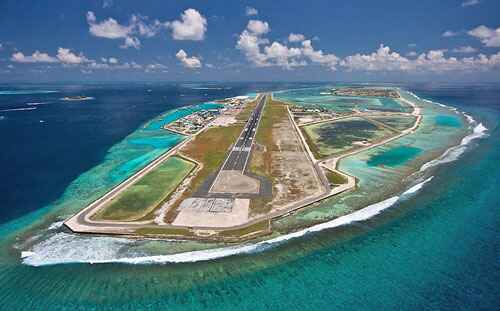
Velana International Airport sits on Hulhule Island in North Male Atoll a separate island from Male city, two kilometres across the water. It handles everything that moves in and out of the Maldives by air: international arrivals, international departures, domestic fixed-wing flights to the regional atolls, and seaplane transfers to dozens of resort islands across the central and northern parts of the country.
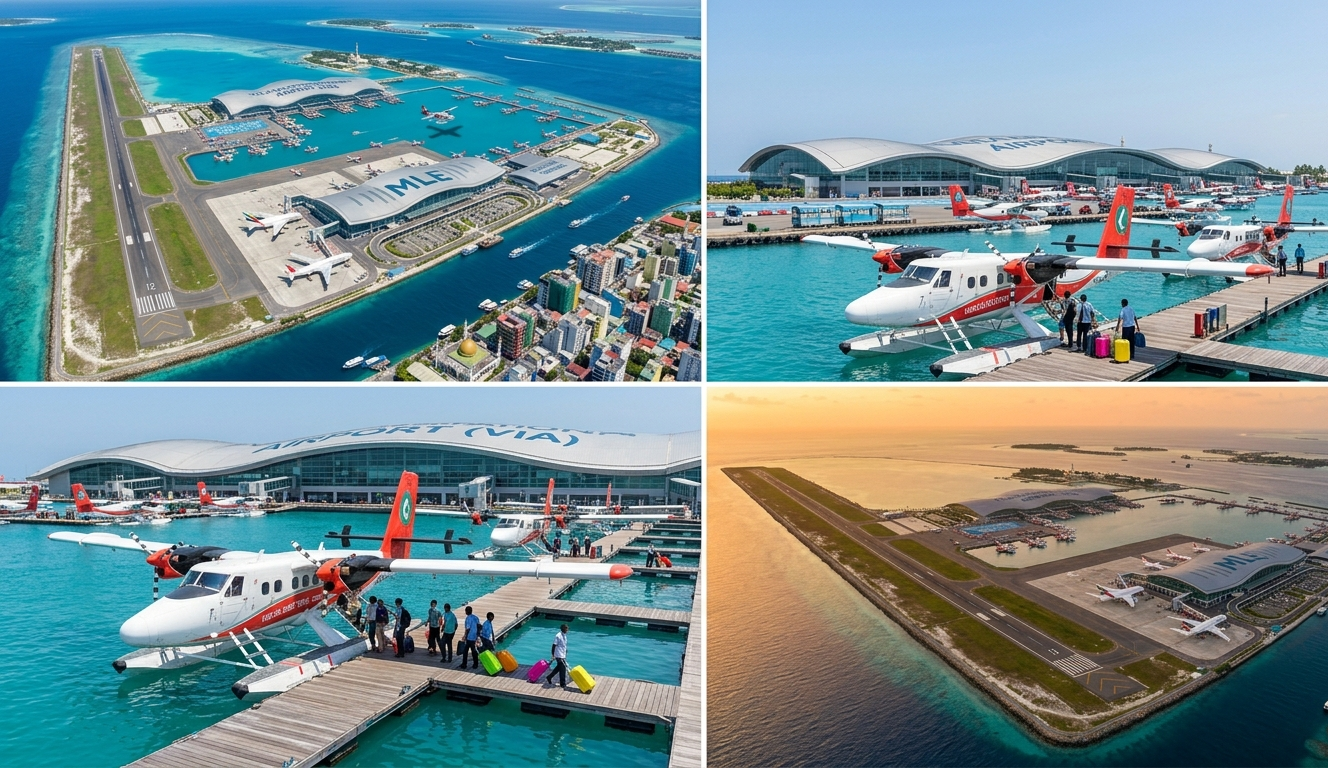
Three terminals operate from the same island. They are not the same building. After landing and clearing immigration in the international terminal, guests heading to a seaplane-access resort walk or transfer to the seaplane terminal. Guests connecting to a domestic flight head to the domestic terminal. Knowing which one applies to the booked resort and where it is relative to arrivals is the first practical thing to understand before landing.
IATA Code: MLE Location: Hulhule Island, North Male Atoll From Male city: 10-minute ferry or speedboat From Hulhumale: connected by road via Sinamale Bridge
The International Terminal Arrivals
Landing at Velana is straightforward for most nationalities. The immigration card distributed on the aircraft should be completed before landing having it done saves time in the queue. Visas on arrival are granted free of charge to most nationalities for stays up to 30 days. No advance application is required.
Immigration during normal arrival volumes is generally efficient most travellers clear within 20 to 40 minutes of landing. During peak season December through April simultaneous arrivals from multiple long-haul flights can extend that to an hour. Building this into transfer planning is sensible.
After baggage reclaim and customs, guests exit into the arrivals hall where resort transfer representatives meet them with name boards. If a resort representative is not immediately visible, the information desks inside the hall provide assistance.
Yellow fever vaccination certificates are required for travellers arriving from countries where yellow fever is endemic. This requirement applies regardless of nationality.
The Seaplane Terminal The Most Important Part of This Airport
The seaplane terminal at Velana International Airport is operated by Trans Maldivian Airways the world's largest commercial seaplane operator and it is the departure point for transfers to resort islands across the central and northern atolls of the Maldives.
For most resort guests, this terminal is where the critical decision plays out.
Seaplanes operate only in daylight. The transfer window is broadly 6am to 5:30pm daily, varying slightly with seasonal light conditions. International flights arriving after approximately 3pm carry a genuine risk of missing the last seaplane departure of the day. This is not an edge case it is a consistent reality that catches underprepared travellers regularly.
The solution is simple but requires advance planning: confirm whether the chosen resort requires a seaplane, check the international arrival time against the seaplane window, and if there is any doubt about making the connection, book a night in Hulhumale or Male and take the first seaplane the following morning. The cost of a planned overnight is significantly less than the cost of an unplanned one both financially and in terms of the experience.
The seaplane terminal waiting lounge has comfortable seating, refreshments, and a viewing area overlooking the seaplane apron. For most guests, the wait here is between 30 minutes and two hours before departure. The seaplane journey itself 15 to 45 minutes depending on the destination atoll is consistently described by first-time visitors as one of the best parts of the whole trip. The view of the atolls from low altitude, the turquoise against the dark blue of the deep ocean, the tiny islands below it sets the tone for what follows in a way that no speedboat transfer quite matches.
Luggage restrictions apply. Seaplane transfers have weight and size limits typically around 20kg of soft baggage per person. Hard-shell cases create problems on seaplanes. Packing in soft bags and staying within the weight limit avoids delays and potential additional charges on arrival day.
The Domestic Terminal - For Distant Atoll Resorts
Guests travelling to resorts in the northern and southern atolls Haa Dhaalu, Raa, Noonu, Laamu, Gaafu Alifu, Addu, and others connect via the domestic terminal to fixed-wing flights operated by Maldivian Airlines and Island Aviation Services.
The domestic flight is followed by a speedboat transfer from the regional airport to the final island destination. This transfer type avoids the seaplane's daylight restriction for the main leg of the journey, though domestic flight schedules have their own timing requirements.
When connecting from an international arrival to a domestic departure, allow a minimum of two to three hours between landing and the domestic flight. This is not excessive it reflects the realistic time needed to clear immigration, collect baggage, transfer between terminals, and check in for the domestic leg.
Airlines Flying Into Male International Airport
Velana International Airport is served by a strong network of international carriers connecting the Maldives to major hubs across the Middle East, Asia, and Europe.
Emirates operates multiple daily flights from Dubai one of the most commonly used routing points for travellers from Europe, Africa, and the Americas. The frequency and connection options from Dubai make Emirates the most versatile single-carrier option for reaching the Maldives from most parts of the world.
Qatar Airways connects through Doha with similarly strong frequency and extensive onward connections. For travellers from European cities with good Qatar Airways service, Doha is often the most direct routing to Male.
Singapore Airlines and Scoot connect from Singapore the preferred hub for travellers from Australia, Southeast Asia, and parts of East Asia. Singapore to Male is a four-hour flight and Singapore Changi is one of the most efficient transit airports in the world, making this routing particularly smooth.
Sri Lankan Airlines connects through Colombo the closest major city to the Maldives at under two hours flying time. For travellers from South Asia specifically, Colombo offers the most frequent and most affordable connections to Male.
Turkish Airlines connects from Istanbul, providing access from across Europe, Central Asia, and Africa for travellers who route through a Turkish Airlines hub.
IndiGo and Air India operate direct flights from multiple Indian cities including Delhi, Mumbai, Bengaluru, and Chennai making the Maldives more directly accessible from India than almost any other major international destination.
Getting From Male Airport to Your Resort
The transfer method from Velana International Airport to the final resort or island destination near male airports is determined entirely by the location of that destination. There is no single answer and understanding which applies to a specific booking is one of the more important pre-trip planning steps.
Speedboat connects the airport to resorts in North Male Atoll and South Male Atoll. Journeys range from 10 minutes for the closest properties to around 45 minutes for those further into the atoll. Speedboats operate at any hour. There are no luggage restrictions. Transfer costs are a fraction of seaplane prices. Resorts accessible by speedboat Baros, Velassaru, Kurumba, Gili Lankanfushi, One & Only Reethi Rah, Anantara Veli are available to arriving guests regardless of what time the international flight lands.
Seaplane connects the airport to resorts across the central atolls Ari Atoll, Baa Atoll, Lhaviyani Atoll, Dhaalu Atoll, Noonu Atoll, and others. The flight is 15 to 45 minutes and operates only in daylight. International arrival timing must be coordinated with the seaplane window. Transfer costs are higher than speedboat typically several hundred dollars per person round trip depending on the destination.
Domestic flight plus speedboat connects the airport to the most distant resorts and local islands in the northern and southern atolls. The domestic flight from Velana to a regional airport is followed by a speedboat from that airport to the final destination. This is the most time-consuming transfer type but covers parts of the Maldives that neither seaplane nor speedboat from Male can reach directly.
Getting Between the Airport and Male or Hulhumale
Ferry to Male - A public ferry runs between the airport jetty and Male throughout the day and early evening. Crossing time is approximately 10 minutes. Cost is minimal. Ferries stop running late at night, at which point speedboat taxis from the airport are the practical alternative.
Speedboat taxi - Available 24 hours from the airport arrival area to Male and Hulhumale. Journey time under 10 minutes. Fares are fixed and displayed at the taxi desks in the arrivals hall.
Road to Hulhumale - The Sinamale Bridge connects Hulhule Island to Hulhumale by road. Taxis from the airport can reach Hulhumale directly without a boat crossing practical for travellers with significant luggage.
Airport Facilities
Duty free is available in both the arrivals and departures sections of the international terminal perfumes, spirits, tobacco, electronics, cosmetics, and Maldivian crafts and souvenirs.
Dining and coffee in the departures lounge and seaplane terminal waiting area covers cafes, fast food, and sit-down restaurants. The quality is adequate for an airport sufficient for a full meal or a long transit wait.
Currency exchange and ATMs operate inside the terminal. US dollars are the most practical foreign currency for the Maldives accepted across the tourism sector and easier to use than Rufiyaa in a resort context. Rufiyaa is useful for ferry fares and local island purchases.
Wi-Fi is available throughout the terminal buildings and in the seaplane terminal lounge. Reliable enough for messaging, email, and video calls during transit waits.
Luggage storage is available for travellers who need to store bags during a transit period or overnight stay in the area.
Overnight Options Near the Airport
Hulhumale is the most practical overnight base for travellers dealing with late arrivals before a seaplane departure. Modern, clean, and connected to the airport by road, it has a growing selection of hotels at mid-range price points. The morning connection to the airport is straightforward and quick 10 minutes by road across the bridge.
Male city is a 10-minute ferry across the water. It offers a wider range of accommodation and restaurants, and the old town the Friday Mosque, the fish market, the waterfront is worth a few hours for any traveller curious about the real Maldives beyond the resort islands. For a planned overnight rather than a forced one, Male is genuinely interesting.
On the airport island itself Hulhule a small number of hotels operate for travellers who want the minimum possible distance between the bed and the departure gate.
Departure From Male Airport
Check-in opens two to three hours before international departure. The process check-in, baggage drop, security, immigration, departures lounge follows the standard international format. The departures lounge has duty-free, dining, and comfortable seating.
The practical note for resort guests: the seaplane or speedboat back to Male from the resort must be timed with enough buffer before the international departure. Seaplanes run on schedules that are weather-dependent, and delays while uncommon do happen. Most resorts build appropriate buffer into the return transfer arrangement. Guests should confirm the planned departure time from the island and cross-reference it against the international flight time when arranging the return journey.