
Is the Maldives Safe to Visit? - Honest Travel Safety Guide 2026
About Is the Maldives Safe to Visit? - Honest Travel Safety Guide 2026
The Maldives is one of the safest tourist destinations in
the world. For the vast majority of visitors across every nationality, every type
of trip, and every budget a holiday in the Maldives passes without any safety
incident of any kind. The question of whether the Maldives is safe deserves a
direct, honest answer rather than the kind of vague reassurance that leaves
travellers more confused than when they started.
This guide covers the real safety picture what the risks are, what they are not, and what travellers genuinely need to know before visiting.
The Overall Safety Picture
Crime against tourists in the Maldives is rare. Violent
crime targeting visitors is extremely uncommon. Most resort islands are private
and gated by their very nature you arrive by boat, you stay on the island, and
the only people present are other guests and resort staff. The self-contained
nature of island resorts means the typical urban risks that travellers
encounter in other destinations simply do not apply here.
On local inhabited islands, the situation is equally calm.
Petty theft is not a significant problem in the way it is in many other tourist
destinations, and most travellers who stay on local islands for budget travel
report feeling entirely safe throughout their stay.
The Maldives is a Muslim-majority country and Islamic values strongly influence public behaviour. This cultural context contributes to a generally respectful and orderly social environment, particularly on the inhabited islands.
Maldives Travel Warnings - What Governments Say
Most major governments including the UK, US, Australia, and EU member
states issue routine travel advisories
for the Maldives that are broadly positive. The standard advice is to exercise
normal precautions, which is the lowest advisory level and equivalent to advice
given for visiting most Western European countries.
There are no active conflict zones in the Maldives. The
country is not subject to terrorism advisories at a level that would affect
tourist travel, though as with any destination, general awareness of
surroundings is always sensible.
Political demonstrations have occurred periodically in Male,
the capital, and travellers are advised to avoid any political gatherings and
to monitor local news if staying in the city. Resort islands are entirely
unaffected by political activity in Male.
The most significant practical warnings issued by governments relate not to crime but to natural hazards the risk of strong currents while swimming and snorkelling, the importance of sun protection in a tropical climate, and the need to observe resort water safety guidelines. These are genuine risks that deserve attention.
Water Safety
The most real safety risk for visitors to the Maldives is in
the water, not on land. The Indian Ocean currents around the atolls can be
powerful, particularly at channel entrances and along reef drop-offs. Swimmers
and snorkellers who venture beyond the protected lagoon without awareness of
current conditions can get into difficulty quickly.
All reputable resorts provide detailed briefings about safe
swimming areas, flag systems indicating conditions, and guidance on when and
where to snorkel. Following resort safety guidance is the single most effective
thing a visitor can do to stay safe in the Maldives.
Scuba diving carries its own specific risks, and all certified dive centres in the Maldives operate under PADI or equivalent safety standards. First-time divers should always complete an introductory course under certified supervision before attempting open water dives.
Health and Medical Safety
The Maldives has limited medical facilities outside of Male.
Remote island resorts typically have on-site first aid capability and a trained
medical officer, but serious medical emergencies require evacuation to Male or,
in extreme cases, medical evacuation to Sri Lanka or India.
Travel insurance with comprehensive medical evacuation
coverage is strongly recommended for all visitors to the Maldives. The cost of
medical evacuation without insurance can be extremely high, and the remoteness
of many resort islands makes this a genuine practical consideration rather than
an abstract one.
Common health considerations include sun exposure and
dehydration both very real risks in a tropical environment with limited shade
on open water. Reef cuts from coral contact can become infected if not treated
promptly, and most resorts have basic wound care facilities.
No vaccinations are specifically required for entry to the Maldives, though standard travel vaccinations such as Hepatitis A and B are generally recommended. Yellow fever vaccination is required for travellers arriving from countries where yellow fever is endemic.
Cultural Considerations That Affect Safety and Respect
The Maldives is a Muslim country and alcohol is prohibited
on inhabited local islands. Public displays of affection are frowned upon in
local communities. Immodest dress outside of designated tourist beach areas on
inhabited islands is both disrespectful and potentially problematic legally.
These are not primarily safety concerns but cultural considerations understanding them and acting accordingly means visitors are received warmly
and avoid situations that could otherwise become uncomfortable.
Resort islands operate under different rules and are licensed to serve alcohol and permit swimwear on resort beaches. The distinction between resort islands and local inhabited islands is important and worth understanding before travel.
Natural Hazards
The Maldives sits at very low elevation the average island
height above sea level is less than two metres. This makes the country
genuinely vulnerable to sea level rise and to the effects of severe weather
events. For individual visitors, this primarily manifests as the reality that
extreme weather during the wet season can disrupt transfers, close dive sites,
and occasionally cause resort facilities to operate in a limited capacity.
The Maldives is not in a major earthquake or volcanic zone,
though it sits in the same ocean region affected by the 2004 Indian Ocean
tsunami. The probability of a tsunami affecting any given visitor during a stay
is extremely low, and modern warning systems are significantly more advanced
than they were in 2004.
Related Maldives Resorts & Hotels
 Related Resort
First Time in Maldives
Planning your very first trip to the Maldives is a very exciting experience, but it is also one of the most misunderstood experiences you can have as a traveler. Unlike other places you might have visited or hope to visit, which allow you to go from city to city, explore places of interest, and create day-by-day itineraries, the Maldives is a very different experience altogether. In the Maldives, your entire experience as a tourist is centered on making the right choice of island resort.The Maldives comprises over 1,000 islands, but only a handful of those islands are developed as resort islands. What this essentially means is that each resort island is a separate entity, a separate world, which is designed to provide you with a self-contained experience, i.e., everything you might want to experience as a tourist is contained within the resort island you are staying at, and you won't be "exploring the Maldives" in the conventional sense of the word.To new travelers, this can be overwhelming. It is natural to think that all Maldives resorts are the same. They have white sand beaches, clear waters, and luxurious villas. This is true to some extent. However, the reality is much more complex. Different resorts have different sizes, atmospheres, price points, and dining options. If you make the wrong choice, you can have few dining options, few activities to do, and even have to pay for things you didn’t anticipate. This is why proper planning is important. When you come to the Maldives, you cannot adjust later. Everything is set in stone. Even the smallest details will make a difference in your vacation.Visa For MaldivesTo enter the Maldives, you don't need a pre-arrival permit. The Maldives follows a visa-on-arrival policy for every nationality. Yet, the preconditions to avail of a visa-on-arrival are a passport with six months validity, a return ticket confirmation to ensure you won't remain in the country, and an ensured hotel booking. Your airline of travel will pass on to you a Maldives immigration form, which is merely a mandatory form to fill in your identification information, inbound and outbound dates, and the affirmation that you're not importing alcohol in the state (yes that's a big one).Immigration in Velana International Airport in the Maldives is fairly easy. Though, it will take slightly longer than the norm because immigration officials usually require a copy of your confirmed hotel reservation and return ticket. You can show these confirmations on your phone, but it is recommended to carry hard copies in order to save time. They will also ask how much USD you're bringing with you, which is only a normal immigration question and not something to worry about. There is no set minimum or maximum amount to bring into the Maldives, but it's best to bring sufficient funds to pay for your expenses during your stay.All About Transportation In The MaldivesSince the Maldives consists of 99% water and 1% land, it is not surprising that first-time visitors might think that sea transport is the only way to travel in the Maldives. This is only half the truth. Transport from Velana International Airport to the different resort islands is either by speedboat or seaplane. Guests are whisked by speedboats to nearby islands in the forty-to forty-minute vicinity, as seaplanes serve to ferry for even further-out areas.For the remote islands, visitors are swept away from the airport to the resort by seaplane. It's a trip in itself, although one with a very steep price tag. A tip if seaplane fare is out of your budget, look for a resort close to the airport. Seaplane transfers from Velana Airport are handled by Trans Maldivian Airways.Most of the time, the cost of the seaplane and speedboat transportation to and from the airport is included in the total accommodation charge at the resort. However, it's best to confirm this with the resort directly before you make your reservation. When you arrive at the Velana International Airport, you'll see booths for about fifty to sixty resort islands located just outside the arrival terminal. One of our resort representatives will be available to meet and escort you to your assigned vehicle of transportation.Is Male Maldives Worth The Visit?Budded in the rich Maldives landscape, Male invites visitors to promises of cerulean water and enchanting culture. Lacking in small stature, Male's bustling capital island provides an enriching amalgam of encounters. From the splendor of the golden-domed Islamic Centre to the twisted streets filled with rainbow-colored bazaars, Male captures Maldivian living.Dive beneath the waves and find yourself in an ocean filled with marine treasures. Snorkel with majestic manta rays or immerse yourself in the rainbow world of coral gardens. Relax on unspoiled beaches, where the wave's rhythm lulls the soul.However, Male is not just a destination it's an experience of Maldivian authenticity. Interact with the people, enjoying traditional food seasoned with exotic spices, and indulge in ancient customs. Whether looking for adventure or relaxation, Male is an odyssey of discovery, a tribute to the lasting charm of the Maldives.Where To Stay In The Maldives?The choice of accommodation in the Maldives is the most critical decision for first-time visitors, as it will determine the entire experience of the vacation. The Maldives has many types of accommodation, ranging from ultra-luxury private island resorts to budget-friendly guesthouses on local islands. If you are looking for the best experience in the Maldives, private island resorts are the best choice, as they offer luxurious over-water villas, beautiful beaches, and world-class services. If you are traveling with family or planning to stay in the Maldives for a long time, you should choose a resort with several facilities, including restaurants. If you are on honeymoon, you should choose a smaller island for the best experience. If you are on a tight budget and looking for the best experience in the Maldives, you should consider local islands, as they offer the best experience in the Maldives at affordable prices.What To See And Do You In The Maldives?The Maldives, a tropical haven of an archipelago in the Indian Ocean, boasts an abundance of stunning landscapes and exhilarating activities. Swim in the crystal waters teeming with a rich variety of marine life, and discover a kaleidoscope of colors in the coral reefs beneath. Among the best are swimming with giant whale sharks and manta rays, or diving shipwrecks and underwater caves.Over the water, the Maldives is a tranquil escape like nowhere else. Laze on spotless white-sand beaches with swaying palm trees, and indulge in healing spa treatments that gaze out across the aquamarine lagoon. For more energetic travelers, embark on a sunset cruise on a classic dhoni, with the sky color-shifting to orange and pink.Immerse yourself in the colorful culture of the Maldives with excursions to local islands and a sampling of traditional Maldivian cuisine, full of coconut, seafood, and fragrant spices. Be sure to explore the lively capital city of Malé and walk through colorful markets, view iconic landmarks, and greet friendly locals.Regardless of whether you desire relaxation, excitement, or culture, the Maldives offers an experience that will be remembered forever and leave you enchanted and rejuvenated.How To Dress-Up In The Maldives?Maldivian formal dressing is a mix of comfort, practicality, and tradition respect. Hot weather requires light, loose, ventilated cotton and linen clothing to keep one cool under the sun's heat. Dress in loose clothes such as long flowing gowns, shorts, and light shirts to remain comfortable when it is hot.In regards to swimsuits, the majority of Maldives resorts do have special beaches where bikinis are perfectly acceptable. Nevertheless, one has to be sensitive culturally when venturing outside these special beaches, particularly if it is in more traditional neighborhoods. In these cases, it is respectful to use a sarong or cover-up when venturing away from beach or poolside regions.You will want shoes to be easy to slip on and off because you will likely spend the majority of your time on sandy shores or swimming pools. Sandals or flip-flops are the most convenient for walking through sandy terrain.Never forget to bring an umbrella or wide-brimmed hat, sun glasses, and plenty of sunscreen to cover your skin from the harsh tropical sun. And never forget, modesty and comfort should go hand in hand to make for a wonderful and respectful venture in this beautiful island haven.What To Eat In The Maldives?When eating out at Maldives, prepare yourself for a flavor so vibrant from colors as vivid as the waters surrounding you. With plenty of sea food and fresh fish, and combinations of Indian, Middle Eastern, and Asian spices, Maldivian food is an adventure in flavors like no other.Seafood Extravaganza: Being an archipelago, the Maldives offers a range of seafood delights. From the tasty lobster to the delectable prawns and fish varieties such as tuna, mahi-mahi, and grouper, there is an oceanic spread to satiate every seafood lover's appetite. Try Maldivian traditional fish curries, barbecued fish, or the popular local dish "mas huni," a delectable mix of shredded smoked fish, coconut, onion, and chili, often accompanied by flatbread.Coconut Infusion: Coconuts surround Maldivian food, bestowing a distinct flavor on nearly every dish. Indulge in rich coconut curries, refreshing coconut water straight from the husk, or indulgent coconut sweets like "bondi" (coconut cake) and "huni roshi" (coconut-filled flatbread).Exotic Fruits: Enjoy the island haven by feasting on a variety of exotic fruits. Whether it is luscious mangoes and papayas or sour pineapples and bananas, the Maldives is blessed with a rich abundance of fresh fruits to tantalize your taste buds. Do not miss trying the local fruits "soursop" and "rambutan" for that authentic tropical taste.Global Influences: Since the Maldives is geographically isolated, it is susceptible to global influences of food coming from the remaining world. Sample international food, which can come in the forms of Japanese sushi and Thai curry or Italian pasta and Indian tandoori cooking. Theme meals are common with most of the resorts, a feature that allows tourists to test various food cultures as well as appreciate the work of sea panoramas.Sweet Endings: Complete your gastronomic tour on a sweet note with rich Maldivian sweets. From "kulhi boakiba" (coconut cake) and "foni boakiba" (sweet rice flour cake) to "bondibai" (coconut custard) and "dodol" (sweet toffee-like confection), there's a sweet delight for every sweet tooth.Best Time To Visit The MaldivesThe Maldives is a tropical country and it remains rainy for all but a minority of the year. The finest time to explore the Maldives is between the months of November and March, which are the summer months for the humid country. May until October is peak rainy season, so if rain doesn't strike you as particularly wonderful then avoid a trip to the Maldives during this duration.Currency In The MaldivesThe Maldivian Rufiyaa is the local currency of Maldives but US dollars are widely accepted and received everywhere in Maldives. It is advisable to receive a little local currency as well as dollars. The Velana International Airport currency swap only accepts very few currencies of the world, hence receive your money exchange from the country of entry.Best Places In The MaldivesThe Maldives, a chain of unmatched beauty in the Indian Ocean, boasts an array of breathtaking locations. One of them is Baa Atoll, a UNESCO Biosphere Reserve, with vibrant coral reefs and abundant marine life. For those seeking seclusion, the isolated island of Dhigurah, with its pristine beaches and blue waters, is the perfect retreat. Meanwhile, the Male capital is a living mosaic of heritage, culture, and modern amenities, with bustling markets and rainbow mosques. The luxury resorts in North Male Atoll offer ultimate pampering in the shape of world-class facilities such as overwater bungalows and opulent spas. Adventure seekers discover Vaadhoo Island's sea of starry lights, created by bioluminescent phytoplankton, an otherworldly experience. Whether it's snorkeling among rare sea life or lounging on deserted shores, the Maldives promises an unforgettable stay in paradise.
 Related Resort
Things to consider when Booking a Hotel in the Maldives
Booking a hotel in the Maldives is very different compared to booking any other hotel anywhere else in the world. The reason for this is the fact that the Maldives is an archipelago of separate islands, each with its own resort. The experience you will have on the island will depend on the resort you choose. Since you will spend most of your time on the island, it is crucial to choose the right resort for your needs. The experience on the island will not be the same as the experience in any city, where you can choose to visit any number of cities. Here, the experience will all be within the resort.In addition to luxury and beauty, each resort is different in terms of atmosphere and activities provided. Some resorts specialize in romance and seclusion, while others specialize in family and adventure. By understanding this, you will avoid disappointment and find a resort that best suits your needs.
 Related Resort
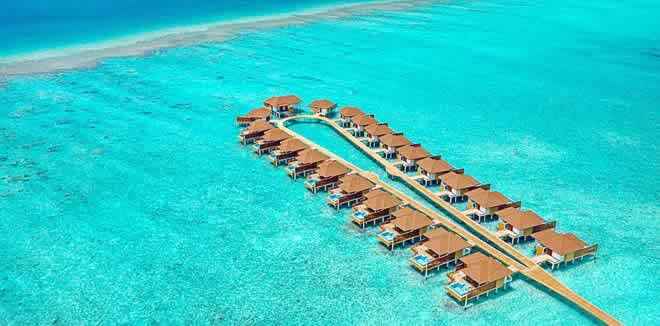
VARU by Atmosphere - A Premium All-Inclusive Resort In Maldives
What differentiates VARU is its unique VARU Plan, which is an all-inclusive package that is really comprehensive, going beyond just meals and drinks. Guests can enjoy:• Special dining experiences such as private beach dinners• Yoga sessions, fitness activities, and gym usage• Some spa treatments• Free high-speed Wi-Fi connectivity• Butler service in premium villasVARU features four different kinds of restaurants and two bars, each offering a unique atmosphere and cuisine. Some of them include:Kaage – For a true taste of Maldives, Kaage is a must-visit. Kaage is a specialty restaurant that offers traditional Maldivian cuisine. Some of the dishes available at Kaage include smoked fish cutlets, yellow snapper curry, and fresh tuna dishes.Charcoal – Located on the beachfront, this is an open-air grill restaurant at VARU. The restaurant offers grilled dishes and is a truly unique experience, especially when you dine beneath the starry skies.Villas & Accommodation• Beach Villas – Spacious, luxurious, and elegant villas located just steps away from the white sandy beach• Water Villas – Overwater bungalows with direct access to the lagoon, complete with glass floor panels for viewing the marine life beneath your villa• Family Beach Villas – Spacious villas, ideal for the whole family, with ample room for all the family to stretch out and enjoy the island lifestyle• Majlis Presidential Suite – VARU’s most luxurious accommodation, with your very own private pool and your very own butler serviceActivities & Water SportsFor those who want more, the diving center provides PADI certified scuba diving lessons and diving excursions. Parasailing, waterskiing, and jet-skiing are also available for those who prefer motorised sports. These activities will be for an additional cost.Elena Spa is an overwater wellness retreat that provides unobstructed views of the sea. One can rejuvenate at this spa through traditional Ayurvedic treatments, deep tissue massages, coconut therapy from Maldives, and even couple therapy. Some of these facilities at this spa are included in the VARU All-Inclusive Plan so that all guests can enjoy wellness from day one of their stay at our resort.Getting ThereVARU is one of the best all-inclusive resorts in Maldives due to our cost-effectiveness, variety of food and drinks, and our top-class service. At VARU by Atmosphere, you can rest assured that you will get everything you need. Whether you’re here to celebrate your honeymoon, anniversary, or to treat yourself to a well-deserved break, VARU is one of the best all-inclusive resorts in Maldives.
 Related Resort
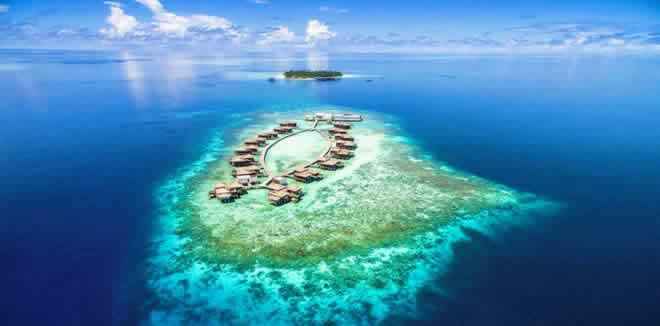
Raffles Maldives Meradhoo
Raffles Maldives Meradhoo resort is located about 55 minutes by seaplane from Velana International Airport in Male. This resort is managed by Raffles Hotels & Resorts. This resort is ideal for couples and honeymooners.Quick Facts• Transfer: ~55-minute seaplane from Velana International Airport (MLE)• Island Layout: Main Island (22 villas) + Overwater Island (16 villas)• Restaurants: 3 restaurants + 2 bars• Butler Service: Included for all villa categories• Check-in / Check-out: 2:00 PM / 12:00 PMResort Layout: Two Private IslandsThe main island is home to 22 villas, including Beach Villas, Deluxe Beach Villas, and Raffles Residences. It also houses the resort's primary facilities: the main swimming pool, the Raffles Spa (overwater), The Thari restaurant, The Firepit restaurant, and the Long Bar. The island features a natural white sand beach and dense tropical vegetation.Overwater IslandRaffles Maldives Meradhoo offers 38 villas and residences across five categories. All villas include dedicated butler service, a private outdoor space or deck, air conditioning, premium bathroom amenities, and complimentary Wi-Fi. The resort positions itself firmly in the ultra-luxury segment, and villa sizes and amenities reflect this positioning.Beach Villa (Main Island)Larger beachfront villas with expanded living areas and a private plunge pool. Positioned on the beach with unobstructed lagoon views and upgraded interior appointments.Raffles Residence (Main Island)16 overwater villas positioned on the overwater island, available in sunrise (east-facing) and sunset (west-facing) orientations. Each villa features a private deck with direct lagoon access, glass floor panel, outdoor bathtub, and direct steps into the Indian Ocean.Overwater Pool Villa (Overwater Island)The resort operates three restaurants and two bars, each with a distinct concept. The Nikkei-themed Yuzu restaurant is the property's signature dining venue and one of the most distinctive restaurant concepts among Maldives resorts.Yuzu – Nikkei Restaurant (Overwater Island)Thari is the resort's main all-day dining restaurant, located on the main island. It serves breakfast, lunch, and dinner with a broad international menu. Breakfast at Thari includes both buffet and a la carte options. The restaurant also hosts themed dinner evenings throughout the week.The Firepit – Beachside Grill (Main Island)A Raffles signature venue, the Long Bar is a reference to the original Long Bar at Raffles Hotel Singapore. At Raffles Maldives, it is a relaxed cocktail bar offering the resort's own interpretation of the Singapore Sling alongside other classic and signature cocktails. Open for evening drinks and sundowner service.Yapa Bar (Overwater Island)The Raffles Spa is an overwater facility on the main island offering treatment rooms with direct views of the lagoon and Indian Ocean. Treatment options include Raffles signature massages, Ayurvedic therapies, body scrubs, facial treatments, and couples' packages. The spa also includes a relaxation lounge, sauna, and steam room. Spa treatments are available as add-ons regardless of the meal plan selected.Activities & Water SportsComplimentary activities:• Non-motorised water sports (kayaking, paddleboarding)• Fitness centre access• Sunset cruises (selected)• Scuba diving (PADI certified dive centre on site)• Deep-sea fishing• Private island picnics• Motorised water sportsRaffles Maldives Meradhoo is one of the more remote luxury resorts in the Maldives. Transfer is by seaplane from Velana International Airport (MLE) in Male, with a flight time of approximately 55 minutes. Seaplanes operate during daylight hours only; guests arriving on late-night flights will need to stay overnight in Male before proceeding to the resort the following morning.Raffles Maldives Meradhoo is positioned in the ultra-luxury segment and is best suited to:• Divers – Gaafu Alifu Atoll offers outstanding diving with remote, less-trafficked sites and reliable large marine life encounters• Culinary travellers – Yuzu's Nikkei cuisine is among the most distinctive restaurant concepts in the Maldives, appealing to guests interested in food as part of the travel experienceRaffles Maldives Meradhoo is one of the Maldives' most exclusive resorts, combining a secluded southern atoll location, a distinctive dual-island layout, 38 villas with butler service throughout, and a strong dining programme anchored by the Nikkei-fusion Yuzu restaurant. It is best suited to couples, honeymooners, and experienced Maldives travellers seeking privacy, exceptional diving, and a resort experience that differs from the more mainstream options in the central atolls.Key differentiator: Dual private island layout, only 38 villas, Nikkei restaurant (Yuzu), butler service for all guests, and access to the remote Gaafu Alifu Atoll dive sites.
 Related Resort
Kagi Maldives Spa Island
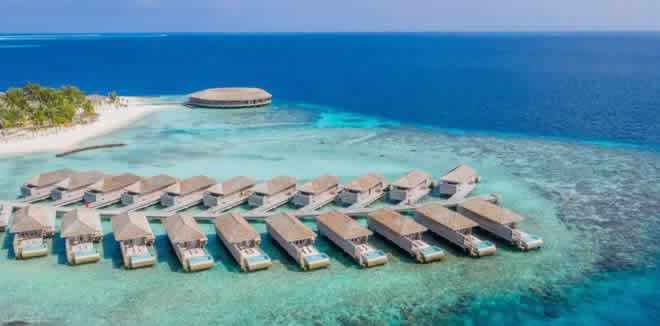
Kagi Maldives Spa Island is a five-star luxury wellness resort located in North Male Atoll, approximately 20 minutes by speedboat from Velana International Airport in Male. The resort opened in 2021 and has quickly established itself as one of the Maldives' leading wellness-focused properties, built around the concept of holistic wellbeing integrated with natural island living.The resort comprises 50 villas, all featuring private plunge pools and direct beach or lagoon access. Its spa and wellness centre is the centrepiece of the resort experience, offering a broad menu of treatments, wellness programmes, yoga, meditation, and fitness facilities. Kagi also operates an all-inclusive dining plan across its three restaurants and two bars. The combination of easy accessibility from Male, an adults-only or couples-oriented atmosphere, and a strong wellness offering makes it a standout choice for guests prioritising health, relaxation, and rejuvenation.Quick Facts• Location: North Male Atoll, Maldives• Transfer: ~20-minute speedboat from Velana International Airport (MLE)• Total Villas: 50, all with private plunge pools• Opened: 2021• Meal Plan: All-inclusive available• Restaurants: 3 restaurants + 2 bars• Spa: Kagi Spa (multi-treatment overwater wellness centre)• Wellness Focus: Yoga, meditation, fitness, holistic treatments• Best For: Couples, wellness travellers, honeymooners, adults• Check-in / Check-out: 2:00 PM / 12:00 PMWellness & Spa at Kagi MaldivesWellness is the defining feature of Kagi Maldives Spa Island and the primary reason most guests choose this resort over other options in North Male Atoll. The resort's spa and wellness facilities are among the most developed of any resort in the Maldives in this price bracket.Kagi SpaThe Kagi Spa is an overwater wellness facility offering a comprehensive menu of treatments. Services include traditional Maldivian massage, Ayurvedic therapies, deep tissue massage, hot stone treatments, body scrubs and wraps, facial treatments, and couples' spa packages. The spa also offers multi-day wellness programmes for guests seeking a more structured approach to wellbeing during their stay. Treatment rooms are positioned over the lagoon, providing natural light and ocean views during sessions.Yoga & MeditationDaily yoga and meditation sessions are held at the resort's dedicated yoga pavilion, which is positioned to take advantage of sunrise and sunset views over the Indian Ocean. Classes are available for all levels, from beginner to advanced. Private one-on-one yoga sessions can be arranged on request. Meditation and breathing workshops are offered as part of the wellness programme schedule.Fitness CentreThe resort's fitness centre is fully equipped with cardio machines, free weights, and strength training equipment. Personal training sessions are available. The fitness centre is open 24 hours and complimentary for all guests.Wellness ProgrammesKagi offers structured multi-day wellness programmes that can be booked as part of a stay. These typically combine daily yoga or meditation sessions, selected spa treatments, wellness consultations, and tailored dietary options at the restaurants. Programme options vary and can be customised to individual guest goals such as stress reduction, detox, or active recovery.Villas & AccommodationKagi Maldives offers 50 villas across several categories, all featuring private plunge pools — a distinguishing feature that sets it apart from many comparable resorts at this price point. All villas include air conditioning, outdoor shower, complimentary Wi-Fi, minibar, and premium bathroom amenities.Beach Pool VillaBeachfront villas with a private plunge pool and direct access to the beach. These villas feature an open-plan indoor-outdoor layout with a furnished outdoor terrace, outdoor shower, and garden area. Suitable for couples seeking a beach-facing accommodation with pool privacy.Deluxe Beach Pool VillaLarger beachfront villas with expanded indoor living space and a more generous private pool area. Positioned along the prime beach frontage of the island with unobstructed lagoon views.Overwater Pool VillaOverwater villas built over the lagoon with a private infinity-style plunge pool on the deck and direct steps into the water. Each villa features glass floor panels, an outdoor sunbathing deck, and panoramic lagoon views. Available in sunrise and sunset orientations.Grand Overwater Pool VillaThe resort's premium overwater category, offering a larger footprint, expanded deck area, a bigger private pool, and upgraded interior furnishings. Ideal for guests seeking maximum space and privacy over the water.Two-Bedroom Pool VillaA larger villa configuration with two separate bedrooms, a shared living area, and a private pool. Suited to small groups, friends travelling together, or families with older children. Note: Kagi is primarily a couples and adults-oriented resort; families with young children should confirm suitability before booking.Dining at Kagi Maldives Spa IslandKagi operates three restaurants and two bars. An all-inclusive meal plan is available and recommended for most guests, as it covers all food and standard beverages across the resort's dining venues. The resort also takes a wellness-conscious approach to its menus, with healthy and plant-based options clearly identified across all restaurants.Onu – Main RestaurantOnu is the resort's primary dining venue and serves an international menu across breakfast, lunch, and dinner. The breakfast spread includes both buffet and a la carte options. Dinner at Onu rotates through themed cuisine evenings throughout the week, covering Asian, Mediterranean, and Maldivian cuisine among others. The restaurant incorporates healthy and plant-based menu options as part of the resort's wellness philosophy.Kagi – Overwater Specialty RestaurantThe resort's signature overwater restaurant serves a curated a la carte menu in an elevated setting above the lagoon. The menu focuses on fresh seafood and contemporary Asian-inspired dishes. This restaurant is best suited to evening dining for couples or guests celebrating a special occasion.Piano Bar & LoungeThe Piano Bar is the resort's social hub in the evenings, offering cocktails, wines, and light bites in a relaxed indoor setting. Live music and entertainment are hosted here on selected evenings throughout the week. The bar also operates as a lounge venue for pre-dinner drinks.Beach Bar & Pool BarThe beach bar and pool bar both offer casual daytime service for drinks, fresh juices, and light snacks. Both bars are included in the all-inclusive plan for standard beverages.Activities & Water SportsWhile wellness is the primary draw at Kagi, the resort also offers a solid range of water sports and marine activities. The North Male Atoll location provides access to well-known dive sites and snorkelling reefs.Complimentary activities:• Snorkelling equipment use• Non-motorised water sports: kayaking, paddleboarding, windsurfing• Daily yoga and meditation classes• Fitness centre access• Guided snorkelling on the house reef• Beach volleyballAvailable at additional cost:• Scuba diving (PADI certified dive centre)• Private yoga and personal training sessions• Motorised water sports: waterskiing, jet skiing, parasailing• Dolphin watching cruises• Sunset fishing trips• Sandbank picnics• Island hopping excursionsHow to Get to Kagi Maldives Spa IslandKagi Maldives is one of the more accessible luxury resorts in the Maldives. It is located in North Male Atoll and reached by a 20-minute speedboat transfer from Velana International Airport (MLE). This short transfer time makes it a practical choice for guests on shorter trips or those arriving on late-night flights, as no overnight stay in Male is required before reaching the resort.The resort arranges all speedboat transfers. Main international flight connections to Male are via Dubai (Emirates), Doha (Qatar Airways), Singapore (Singapore Airlines), Colombo (SriLankan Airlines), and Kuala Lumpur (Malaysia Airlines).Who Is Kagi Maldives Spa Island Best For?• Wellness travellers – The resort's spa, daily yoga programme, fitness centre, and structured wellness packages make it one of the best-equipped wellness resorts in the Maldives• Couples & honeymooners – All villas feature private plunge pools, and the intimate resort scale creates a romantic atmosphere well suited to couples• Guests seeking easy access – The 20-minute speedboat transfer from Male airport is among the shortest of any luxury resort in the Maldives, making Kagi accessible without the complexity of seaplane logistics• All-inclusive travellers – The all-inclusive plan covering meals, beverages, and selected activities offers predictable holiday costs• First-time Maldives visitors – The accessible location, comprehensive facilities, and all-inclusive option make it a solid introduction to Maldives resort travelSummaryKagi Maldives Spa Island is a strong choice for wellness-focused travellers seeking a luxury Maldives resort with genuine depth in its spa and wellbeing offering. The combination of 50 private-pool villas, a comprehensive wellness programme, all-inclusive dining, and a very short 20-minute transfer from Male airport gives it a competitive edge in the North Male Atoll luxury segment.Recommended for: Wellness travellers, couples, honeymooners, and first-time Maldives visitors seeking luxury with easy access and a health-focused resort experience.Key differentiators: All 50 villas include private plunge pools; wellness-first resort concept with structured programmes; 20-minute speedboat from Male; all-inclusive dining plan available.
 Related Resort
The Nautilus Maldives Baa Atoll
Some resorts give you a holiday. The Nautilus gives you something closer to a life — lived entirely on your own terms, on a private island in one of the most biodiverse corners of the Indian Ocean.The Nautilus Maldives is an ultra-luxury private estate resort located in Baa Atoll, a UNESCO Biosphere Reserve in the northern Maldives. With just 26 estates — a mix of beachfront and overwater residences — it is one of the most exclusive resorts in the country by design. The philosophy here is deliberately different from the typical resort model: there are no set mealtimes, no rigid schedules, no menus you can't deviate from. Instead, every detail of your stay is shaped around you.The resort is positioned just minutes from Hanifaru Bay — one of the world's most famous manta ray aggregation sites — making it a rare combination of serious marine access and serious luxury. If you've spent time researching the Maldives and keep finding yourself drawn back to Baa Atoll for the wildlife but frustrated by the lack of truly top-end options in the area, The Nautilus is the answer to that search.Quick Facts• Location: Baa Atoll, UNESCO Biosphere Reserve, Maldives• Transfer: ~25-minute seaplane from Velana International Airport (MLE)• Total Estates: 26 (beachfront and overwater)• Resort Style: Ultra-luxury, no fixed schedules, fully bespoke• Dining: Freestyle dining — no set times or fixed menus• Restaurants / Bars: Multiple dining venues + private in-estate dining• Nearby: Hanifaru Bay (manta ray aggregation site)• Best For: Couples, honeymooners, divers, ultra-luxury travellers• Award: The Nautilus Retreat named one of the most extreme villas in Maldives, T+L Luxury Awards Asia Pacific 2024• Check-in / Check-out: Flexible, by arrangementThe Nautilus Philosophy: Life Without Fixed RulesMost luxury resorts, no matter how beautiful, still operate within a framework of rules — breakfast ends at 10:30, the restaurant opens at 7, spa bookings must be made 24 hours in advance. The Nautilus was built to reject that model entirely.Here, there are no set dining hours. The kitchen works around your appetite, not a schedule. Want a long breakfast at noon? Done. A private dinner at the edge of the lagoon at 11pm? Arranged. Feel like paddleboarding at dawn and then sleeping until 2pm? Nobody will knock on your door. This is what the resort means when it talks about 'life unrestricted' — and unlike many properties that use similar language as marketing copy, at The Nautilus it actually describes how the place runs.Each estate comes with a dedicated team — a private butler, chef, and personal assistant — whose sole responsibility is your experience. This level of staffing per guest is rare anywhere in the Maldives and is the practical mechanism that makes the no-rules philosophy actually work.The EstatesThe Nautilus uses the word 'estate' rather than 'villa' deliberately — these are not hotel rooms with a view, but fully private residences on the water or beach, each with its own pool, living spaces, and dedicated team. There are 26 in total, split between beachfront and overwater positions.Beach EstateSet directly on the white sand beach of Baa Atoll, the Beach Estates are generous in scale, with open indoor-outdoor living areas, a private pool, lush tropical garden, and an outdoor shower. The architecture draws on Maldivian design traditions while keeping the interior feeling contemporary and uncluttered. From your terrace, the lagoon is a few steps away.Ocean Estate (Overwater)Built over the Indian Ocean on stilts, the Ocean Estates offer the full overwater Maldives experience at the highest level. Each estate features a spacious deck with a private infinity pool, direct steps down into the lagoon, glass floor panels, and panoramic ocean views from both the bedroom and living area. These are among the most spacious overwater accommodations in the Maldives.The Nautilus Retreat (Two-Bedroom Ocean Estate)At 542 square metres, The Nautilus Retreat is the resort's flagship accommodation and one of the most talked-about villas in the Maldives. Suspended over the lagoon on stilts, it houses two bedrooms — each with its own ocean view and en-suite bathroom — arranged around a central living and dining area. The curved sundeck wraps around a soft-edged infinity pool with sunset views across open water.In 2024, the Retreat was named one of the most extraordinary villas in the Maldives by the Travel + Leisure Luxury Awards Asia Pacific. It is suited to couples travelling together, small families seeking total privacy, or anyone who simply wants the most exceptional accommodation on the island.Dining at The NautilusDining at The Nautilus works the way it should at home: you eat when you're hungry, what you feel like eating, where you want to eat it. The resort's culinary team operates across several dining settings — a main restaurant, a beach grill, a bar and lounge — but the most memorable meals here are often the private ones: a table set on your estate deck as the tide comes in, a picnic on a nearby sandbank, or a late-night meal cooked by your private chef while the lagoon glows with bioluminescence.The menus draw on fresh seafood, Maldivian produce, and international techniques, and can be adapted entirely to dietary requirements or personal preferences. This isn't a resort where you work around what's available — the kitchen works around you.Main RestaurantThe resort's main dining venue serves breakfast, lunch, and dinner with a menu that changes daily and incorporates fresh catch from local waters alongside international produce. Open kitchen format allows guests to interact with the culinary team.Beach GrillAn informal, open-air beachside grill for evenings when you want the sound of the ocean and the smell of charcoal. Grilled seafood, meats, and local vegetables served directly on the sand with feet-in-water dining available.In-Estate Private DiningEvery estate has access to in-residence private dining at any hour, prepared by your personal chef. Menu options are entirely flexible. This is the most popular dining choice among guests and is included as standard with the estate package.Sandbank & Excursion DiningFor those who want to take the dining experience beyond the island itself, the resort arranges private sandbank dining — a table set up on a deserted sand strip in the middle of the Indian Ocean, miles from anything. This is one of the most sought-after experiences guests request, and one that The Nautilus executes consistently well due to the logistics that come with 26 estate-level service ratios.Baa Atoll & Hanifaru Bay – Why the Location MattersThe Nautilus is one of the very few ultra-luxury resorts situated within Baa Atoll — and that matters more than it might initially seem. Baa Atoll is a UNESCO Biosphere Reserve, and the marine environment here is exceptional even by Maldivian standards. The coral reef health, fish diversity, and large-animal encounters in this atoll consistently outperform more visited areas like North Male Atoll.Most significantly, The Nautilus sits just minutes from Hanifaru Bay — a protected marine sanctuary and the world's single most reliable site for mass manta ray feeding aggregations. Between June and November, dozens of manta rays gather to feed on plankton-rich currents at Hanifaru, and snorkellers and divers who witness this describe it as one of the most extraordinary wildlife experiences in the ocean. Whale sharks are also regularly encountered at the same site.Access to Hanifaru Bay is regulated and requires a permit — the resort arranges this for all guests. Entry is by snorkelling only (no scuba diving is permitted inside the bay), which makes the experience equally accessible to non-divers and underlines why the house reef and surrounding atoll are equally important for guests who do dive.Activities & ExperiencesBecause The Nautilus operates on a bespoke, schedule-free model, activities are arranged individually rather than through a fixed programme. This means you can do as much or as little as you want, and everything is tailored to your group's pace and preferences.Marine & water experiences:• Snorkelling at Hanifaru Bay (manta ray and whale shark aggregations, seasonal)• Scuba diving with PADI-certified dive centre• House reef snorkelling directly from the estate• Freediving• Kayaking, paddleboarding, windsurfing• Private sunset cruises• Sandbank excursionsOn-island experiences:• Spa treatments (massage, body treatments, facials, couples packages)• Yoga and meditation (at the pavilion or on your estate deck)• Cooking classes with the resort chef• Photography sessions at sunrise and sunset• Stargazing from the ocean estates• Island fishing — traditional Maldivian night fishing by hand lineWho Is The Nautilus Best For?The Nautilus is not the right choice for every traveller — and that's by design. It is a small, premium-priced resort that rewards guests who value privacy, personalisation, and a genuine connection to the natural environment over large pools, big entertainment programmes, or buzzing beach bars.• Couples & honeymooners — The private estates, bespoke dining, and utterly unhurried atmosphere make it one of the best honeymoon resorts in the Maldives for those with the budget to match• Marine enthusiasts — The Hanifaru Bay location and exceptional house reef make this a standout choice for anyone who wants world-class snorkelling and diving as a central part of their trip• Repeat Maldives visitors — Guests who have already stayed at several Maldives resorts and are looking for something genuinely different often find The Nautilus to be the resort that finally feels like it gets the concept right• Privacy seekers — With only 26 estates and a private-chef-per-estate model, you will rarely feel like you are at a hotel at all• Celebration trips — The flexibility around dining, activities, and schedules makes it particularly well suited to milestone anniversaries, significant birthdays, or any trip where you want the experience to feel truly personalHow to Get to The Nautilus MaldivesThe Nautilus is reached by a 25-minute seaplane transfer from Velana International Airport (MLE) in Male. Seaplanes operate during daylight hours only, so guests arriving on late-evening or overnight flights will need to stay in Male before proceeding to the resort the following morning. The resort can arrange Male accommodation and overnight logistics on request.Main international connections to Male include Dubai (Emirates), Doha (Qatar Airways), Singapore (Singapore Airlines), Colombo (SriLankan Airlines), and Istanbul (Turkish Airlines). The seaplane journey itself — skimming low over hundreds of coral atolls and turquoise lagoons — is its own experience and a fitting introduction to what awaits.Our TakeThe Maldives has no shortage of beautiful resorts. What it has a shortage of is resorts that genuinely operate differently — that feel, from the moment you arrive to the moment you reluctantly leave, like the experience has been designed specifically for you. The Nautilus is one of the very few that earns that description honestly.Add the Hanifaru Bay manta ray access, the UNESCO-protected Baa Atoll marine environment, and the T+L award-winning Nautilus Retreat villa, and you have one of the most compelling resort propositions in the Maldives — particularly for guests who have been to the islands before and are looking for a step up.Best for: Couples, honeymooners, marine enthusiasts, and experienced Maldives travellers seeking ultra-luxury with genuine flexibility and world-class snorkelling at Hanifaru Bay.Key differentiators: Only 26 estates — each with private chef, butler, and personal assistant; no fixed dining times or menus; proximity to Hanifaru Bay (manta rays, whale sharks); Baa Atoll UNESCO Biosphere Reserve location; T+L award-winning Nautilus Retreat villa.